
Worth Knowing
What Kind of Barker Lives in Your House?
Meet the security guard, the frustrated greeter, the customer service desk—and the other very vocal departments operating from your home.
Barking is not one behavior with one meaning. Reading what happens before, during and after it can reveal what your dog may actually need.
The delivery truck touches one wheel to your street.
Barking.
Dinner is approximately 90 seconds later than expected.
More barking.
A dog appears across the road, someone closes a car door three houses away, or you make the grave mistake of leaving the room without issuing a formal statement.
To human ears, it can all sound like the same problem: the dog is barking again.
But barking is not one behavior with one meaning.
Dogs may bark in response to territorial concerns, fear, play, other barking dogs or a reaction they have learned to expect from their humans. The same dog can also bark for completely different reasons at different times.
Research has even found measurable differences between barks recorded during disturbances, isolation and play—although sound alone cannot reliably tell us the whole story. So before trying to make the house quieter, it helps to work out which department is currently handling communications.
Before the profiles
Read the scene, not just the sound
You do not need to become a canine acoustics expert. Start by watching what happens around the bark.
Worth remembering: These profiles are not diagnoses, and your dog may belong to several of them. They are simply a more useful place to begin than treating every bark as disobedience.
Barker profile 01
The Security Guard
Primary jurisdiction
Windows, doors, hallways and highly suspicious delivery drivers.
The Security Guard notices everything.
A person walks toward the house. A dog passes the car. A neighbor moves a trash can without prior authorization. Your dog rushes toward the boundary, barks and monitors the situation until the potential intruder leaves.
This can be consistent with alert or territorial barking. From the dog’s perspective, the system also appears extremely effective: the mail carrier approaches, the dog sounds the alarm and the mail carrier leaves.
Mission accomplished.
Start here
What to try first
Reduce the rehearsal. Frosted window film, closed curtains, background sound or moving a favorite lookout spot can reduce the number of events your dog feels responsible for managing.
Create a handoff routine. Acknowledge the alert, call your dog away and reward them for checking in, moving to a mat or settling elsewhere.
The goal does not have to be a dog who never alerts. It can be a dog who says, “Something is happening,” and then confidently hands the case over to management.
Barker profile 02
The Frustrated Greeter
Primary jurisdiction
Leashes, fences and anything standing between the dog and where they want to be.
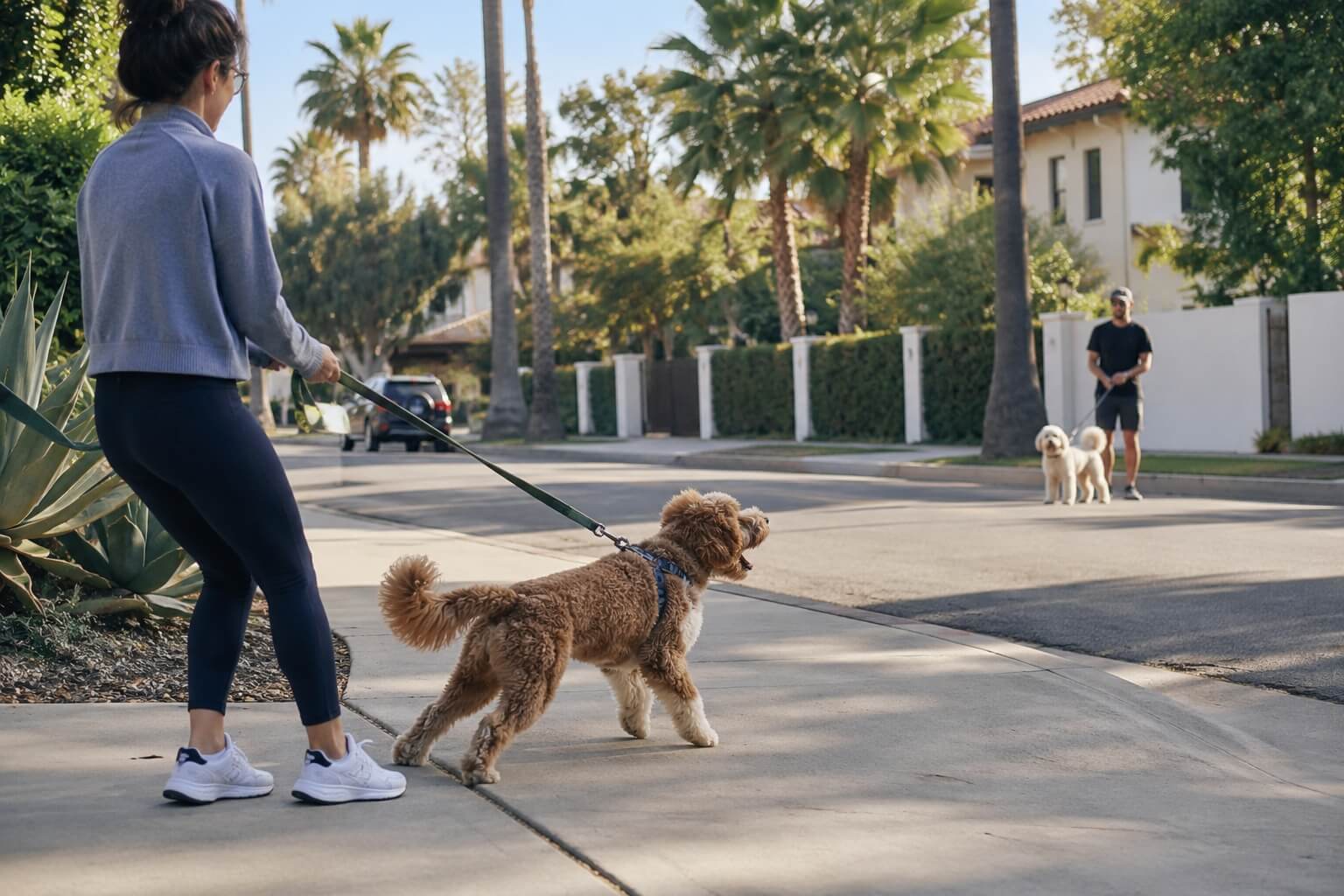
This dog sees another dog across the street and suddenly appears to have several urgent opinions.
They may pull forward, bounce, whine, bark or struggle against the leash. Some frustrated greeters genuinely want to approach. Others are worried and trying to create distance—and excitement and fear can exist together.
Enthusiasm alone does not guarantee that a greeting will be safe or enjoyable.
Start here
What to try first
Create distance first. A dog who is already barking and lunging may be too overwhelmed to learn much in that moment.
Cross the street, change direction or use a parked car as a visual barrier. At a manageable distance, reward your dog for noticing the trigger and then checking back in with you.
Do not make meeting every dog the reward for pulling toward every dog. Sometimes the most useful social skill is learning that another dog can exist nearby without becoming the next item on the calendar.
Barker profile 03
The Customer Service Desk
Primary jurisdiction
Dinner, doors, toys and immediate resolution of all open requests.
The Customer Service Desk does not bark randomly.
They bark while looking at the food bowl.
They bark beside the back door.
They bark, look at the toy under the couch and then look back at the only employee apparently qualified to retrieve it.
When barking repeatedly produces attention, food, play or access, it can become a learned and highly efficient request system. Veterinary behavior resources describe attention-seeking barking as a normal behavior that can grow through inadvertent reinforcement.
Start here
What to try first
Check the request first. A dog who genuinely needs the bathroom is not launching a behavioral coup.
For predictable requests, teach a quieter alternative—such as sitting by the door, bringing a toy, going to a mat or making eye contact—and reward it before the barking begins whenever possible.
“Bark 17 times. Human resists. Bark an 18th time. Human folds.”
From the dog’s perspective, the 18-bark package worked perfectly.
Barker profile 04
The Underbooked Commentator
Primary jurisdiction
Narrating the afternoon because nobody scheduled anything better.
This dog patrols the house looking for material.
A distant noise. A bird. A moving curtain. Another dog barking somewhere beyond the known world.
Not every vocal dog is bored, and more exercise is not automatically the answer. But dogs without appropriate outlets for movement, sniffing, problem-solving, chewing and foraging may create their own activities—sometimes loudly.
Start here
What to try first
Give your dog a job that suits the dog in front of you.
For a sniffer: scatter part of a meal or create a short scent trail.
For a chewer: offer an appropriate long-lasting option.
For a problem-solver: try a food puzzle or three minutes of positive training.
The answer does not always need to be a five-mile run followed by another five-mile run. Sometimes it is ten thoughtful minutes during the part of the day when the commentary usually begins.
Barker profile 05
The Dog Asking for Space
Primary jurisdiction
Unfamiliar visitors, uncomfortable interactions and things that have come far too close.
This bark may sound forceful, but the dog producing it may be frightened.
Look beyond the volume. A worried dog may lean backward, tuck or lower the tail, pull the ears back, turn the head away, lick the lips, pant, stiffen or try to retreat.
People often miss the less obvious signs surrounding the bark, particularly when the trigger seems ordinary to us.
Start here
What to try first
Create distance.
Do not force the dog to remain near the visitor, noise or other dog to “get used to it.” Use gates, another room, a wider walking route or a calm exit.
Do not punish the warning while leaving the dog in the same uncomfortable situation. The bark is information arriving before the situation escalates.
Fearful or intense reactions may require a veterinarian, veterinary behaviorist or qualified reward-based behavior professional. AVSAB recommends environmental management and reward-based behavior modification rather than aversive training methods.
Barker profile 06
The Home-Alone Broadcaster
Primary jurisdiction
Reporting your departure to the entire neighborhood.
You may never hear this dog bark yourself.
The barking starts after the keys jingle, the door closes or the car leaves. It may continue briefly before the dog settles—or it may be part of a larger pattern of distress.
Guessing from the neighbor’s note is difficult. Recording your dog is much more useful.
Start here
What to try first
Record the first 20 minutes. Set up a phone or camera after a normal departure and watch whether your dog settles, remains focused on the exit or becomes increasingly distressed.
Home-alone video is especially useful because it shows what actually happens after the person leaves—not only what a neighbor reports hearing.
Persistent barking, frantic behavior or an inability to settle should not automatically be dismissed as boredom or stubbornness. Share the recording with your veterinarian or a qualified behavior professional before starting a training plan.
Worth knowing
A sudden change deserves attention
Sudden, intense or unexplained barking can sometimes be connected to pain, illness, sensory changes or cognitive decline. If your dog’s behavior has changed unexpectedly, start with your veterinarian.
Putting it together
One dog can run several departments
Your dog might be the Security Guard at 9 a.m., the Frustrated Greeter during the afternoon walk and the Customer Service Desk when dinner reaches a critically delayed status at 5:02.
The label is not the solution. The pattern is.
Once you identify what happens before the bark, what your dog appears to need and what consequence follows, you can make a more useful plan.
The Fetch takeaway
The best question is not simply, “How do I stop the barking?” It is, “What is the barking doing for my dog?”
Because the bark is only the headline.
The dog underneath it is the story.
Sources & further reading
UC Davis School of Veterinary Medicine: Barking in Dogs
AAHA: Supporting Mental and Emotional Wellbeing Through Enrichment
AVSAB: Humane Dog Training Position Statement
This article provides general educational information and is not a diagnosis or substitute for veterinary or professional behavior advice. Sudden, intense or unexplained behavior changes should be discussed with your veterinarian. Seek qualified professional support when barking involves fear, distress, aggression or a risk to people or animals.


