You scoop the kibble, give the bowl a little shake, and perhaps add a treat because someone is looking at you like they haven’t eaten since Tuesday.
The bag has a feeding chart. You follow it. Dinner is handled.
Except that chart doesn’t know whether your dog spends the afternoon chasing tennis balls or supervising the couch. And even when the amount is right on paper, the way you measure it can change what actually lands in the bowl.
So how can you tell if your dog is getting the right amount? Whether they eat kibble, canned food, fresh meals or a mix, start with your dog, not the scoop.
The feeding chart is a starting point, not a prescription
Commercial dog foods — dry, wet or fresh — typically provide feeding directions based on weight and life stage. They’re useful for estimating a starting portion, but dogs of the same weight can have different energy needs depending on age, activity, neuter status and health.
The amount that keeps one dog at a healthy weight may be too much or too little for another. That’s why veterinary nutrition guidance puts so much emphasis on body condition and weight trends rather than simply following the number printed on the package. If you prepare meals at home, use a recipe formulated with a board-certified veterinary nutritionist; getting the portion right doesn’t guarantee a nutritionally complete meal.
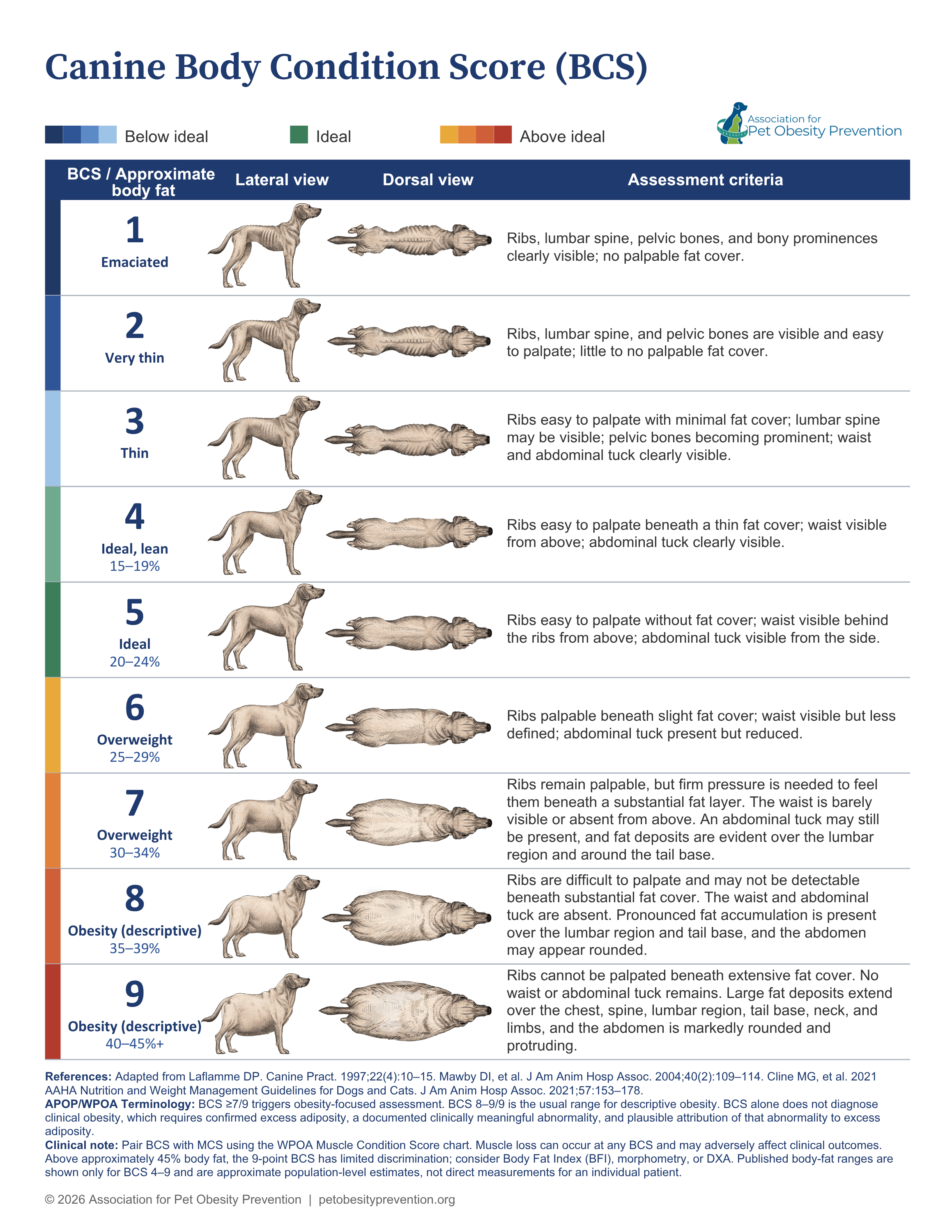
Try this three-part body check
It takes about a minute and uses something you already have: your hands. Veterinarians call this a body condition assessment.
| 01 | Feel the ribs. With flat fingers, gently feel along your dog’s ribcage. You should be able to find the ribs beneath a light layer of fat without having to press hard. Ribs that are very prominent or difficult to feel are worth discussing with your vet. |
| 02 | Look from above. Stand over your dog and look for a waist — a narrowing just behind the ribcage. The curve may be more subtle in some breeds. |
| 03 | Look from the side. You’ll usually see the belly rise from the chest toward the back legs. A heavy coat can hide this, so the hands-on rib check is especially useful. |
Worth knowing: On the common nine-point body condition scale, many healthy adult dogs fall around 4–5/9. See the visual body-condition chart (1–9) to compare what you feel and see.
A body check gives you a clue, not a diagnosis. Your veterinarian can assess body fat alongside muscle condition — particularly important for older dogs, whose muscle loss can be missed when we focus on weight alone.
Your measuring cup might be fooling you
That scoop of dry kibble you’ve been using for months? It may not be as consistent as you think. In a study of 100 dog owners, portions measured with cups and scoops varied widely from the intended amount. Smaller portions were especially tricky to measure accurately.
For kibble, a kitchen scale is a simple upgrade: weighing it in grams makes portions more consistent. If you serve canned or fresh food, measure those portions too, and check the calories per can, tray or gram. The same weight of two different foods can provide very different calories.
Here’s why small differences matter with dry food: a kibble labeled 3,600 kcal/kg contains 3.6 calories per gram. An extra 20 grams adds 72 calories — before any treats. That’s just an illustration, not a suggested portion.
You don’t have to become your dog’s personal accountant. Just find out what you’re actually serving.
The five-minute feeding audit
You can do this today without changing your dog’s diet. The goal is to get an accurate picture of what goes in.
| 01 | Check the label or feeding plan. For packaged foods, check the feeding instructions, calorie content and whether the amount is per day or per meal. For home-prepared meals, refer to your veterinary nutritionist’s recipe and portion plan. |
| 02 | Measure one full day’s food. Weigh the food you normally serve in grams, or note exactly how many cans or trays you use. If you combine kibble with wet or fresh food, record each separately. Don’t change the amounts yet — first find out what your dog actually eats in a day. |
| 03 | Count the extras. Include training treats, dental chews, toppers, table scraps and snacks used to hide medication. Those calories don’t disappear just because they weren’t served in the bowl. |
One rule worth remembering: the American Animal Hospital Association recommends that treats and other extras account for no more than 10% of daily calories, so the main nutritionally complete diet provides the rest. If practical, reserve some of your dog’s usual daily food for training instead of adding more snacks.
And yes, that innocent-looking dental chew counts. So does the piece of cheese from the kitchen. Your dog may have a different opinion.
So, should you change the amount?
Not automatically. If your dog has a healthy body condition and a stable weight, your current portion may already be working well.
If the rib-and-waist check raises questions, or your dog’s weight is drifting up or down, record what you feed and ask your veterinary team to help set the right amount. Don’t make a large cut or increase based on one home check. Unexplained or rapid weight loss needs prompt veterinary attention. Puppies, pregnant or nursing dogs, dogs with medical conditions and seniors losing weight or muscle need especially individualized advice.
Keep an eye on the trend by checking weight periodically on the same scale and repeating the body check. The goal isn’t to hit a universal number of cups, cans or grams. It’s to find a portion that keeps your dog in good condition over time.
Your dog will probably continue to insist that dinner should be bigger. Fortunately, you now have three better ways to judge: how their body feels, how much food you’re actually serving, and what happens to their weight over time.
That’s a lot more useful than letting the begging eyes have the final vote.