
Training, Made Simple
You reach into the treat bag and suddenly your dog is a model student. Sit? Absolutely. Down? Already there. Come? They are halfway across the room before you have finished saying it.
Then you try the exact same thing with empty hands. You say “sit,” your dog looks at you, then at your hands, and suddenly you are wondering whether you have accidentally created a tiny negotiator who needs proof of payment before doing anything.
The good news is that using treats is probably not the problem. Food is a great way to teach new behaviors. The issue is more likely that your dog has learned to look for the treat before deciding what to do. In other words, seeing the food has become part of the cue.
The short version
Don’t rush to remove the reward.
Remove the need to see it first.
The big shift
A lure is useful, but it should not stay forever
Imagine teaching a puppy to sit for the first time. You hold a treat near their nose, move it slightly up and back, and as their head follows the food, their bottom drops toward the floor. That is a lure doing exactly what it is supposed to do: helping the dog understand the movement.
The next step is teaching your dog that they can do the same thing without the treat guiding them. If the food stays in your hand for too long, your dog may start waiting for the whole setup: the treat, your hand position, even the little movement toward your pocket, instead of responding to the cue itself.
That is the shift you are aiming for: the reward still matters, but it should come after your dog responds, not before.
Start with the empty-hand test
Pick a cue your dog already knows well. “Sit” is ideal because there is no reason to make this exercise complicated. Put a few small treats somewhere your dog cannot see them — in your pocket, in a pouch behind you or in a container on a nearby counter.
Stand normally with your hands relaxed and say “sit” once. Give your dog a moment to respond. If they sit, mark that exact moment with your usual “yes,” clicker or other marker. Only then should your hand move toward the food. Take out the treat, reward your dog and reset for another repetition.
Pay attention to your own body while you do this. Dogs are excellent at noticing patterns, and the small movement you make toward a treat pouch can become more meaningful than the word you think you are teaching. Say the cue, pause, let your dog answer, and move only after the behavior happens.
The order matters
01. Give the cue with empty hands.
02. Give your dog a moment to respond.
03. Mark the correct behavior.
04. Only then reach for the reward.
What if your dog does absolutely nothing?
This is the moment when many of us instinctively reach for a treat, wave it around and ask again. Unsurprisingly, the dog suddenly performs beautifully. It feels like proof that they “won’t do it without food,” but showing the treat at that point can reinforce the exact pattern you are trying to change: waiting until the reward becomes visible before responding.
Instead, make the exercise easier. If your dog genuinely looks confused, use the lure once to remind them what the behavior is, reward that success, then reset and try again with the food hidden. You might move from one repetition with the lure, to one with a familiar hand signal, and then to the verbal cue on its own.
If the behavior still disappears when the food does, that is useful information. The cue may not be as solid or as independent as you thought. That is not stubbornness, it simply means your dog needs a little more practice before the food can fully move out of the picture.
Quick check
If your dog only responds when food is visible
| 01 | Can they do it in a quiet room? If not, the behavior itself may need more teaching. |
| 02 | Can they do it with the treat hidden? If not, the lure may still be part of the cue. |
| 03 | Does it fall apart outside? The environment may be too difficult rather than the reward too weak. |
| 04 | Do you move toward the food before they respond? Your body may have quietly become part of the signal. |
The mistake to avoid
Don’t go from “treats every time” to nothing
Once your dog knows a behavior, it’s easy to think the treats should disappear completely. But if sitting, coming when called or checking in with you suddenly stops leading to anything worthwhile, those behaviors can become less rewarding than everything else competing for your dog’s attention.
And the outside world is very good at paying. Sniffing is rewarding. Chasing something that moves is rewarding. Greeting another dog can be rewarding. Even a suspicious sandwich wrapper on the sidewalk may be more interesting than whatever you’re asking.
That’s why removing the lure and removing the reward are two different things. You want your dog to stop needing to see the food before responding fairly early. But the behavior should still lead to something worthwhile afterward: food, play, sniffing, access or another reward your dog values.
Remember this
Fade the lure first.
Make reinforcement more flexible later.
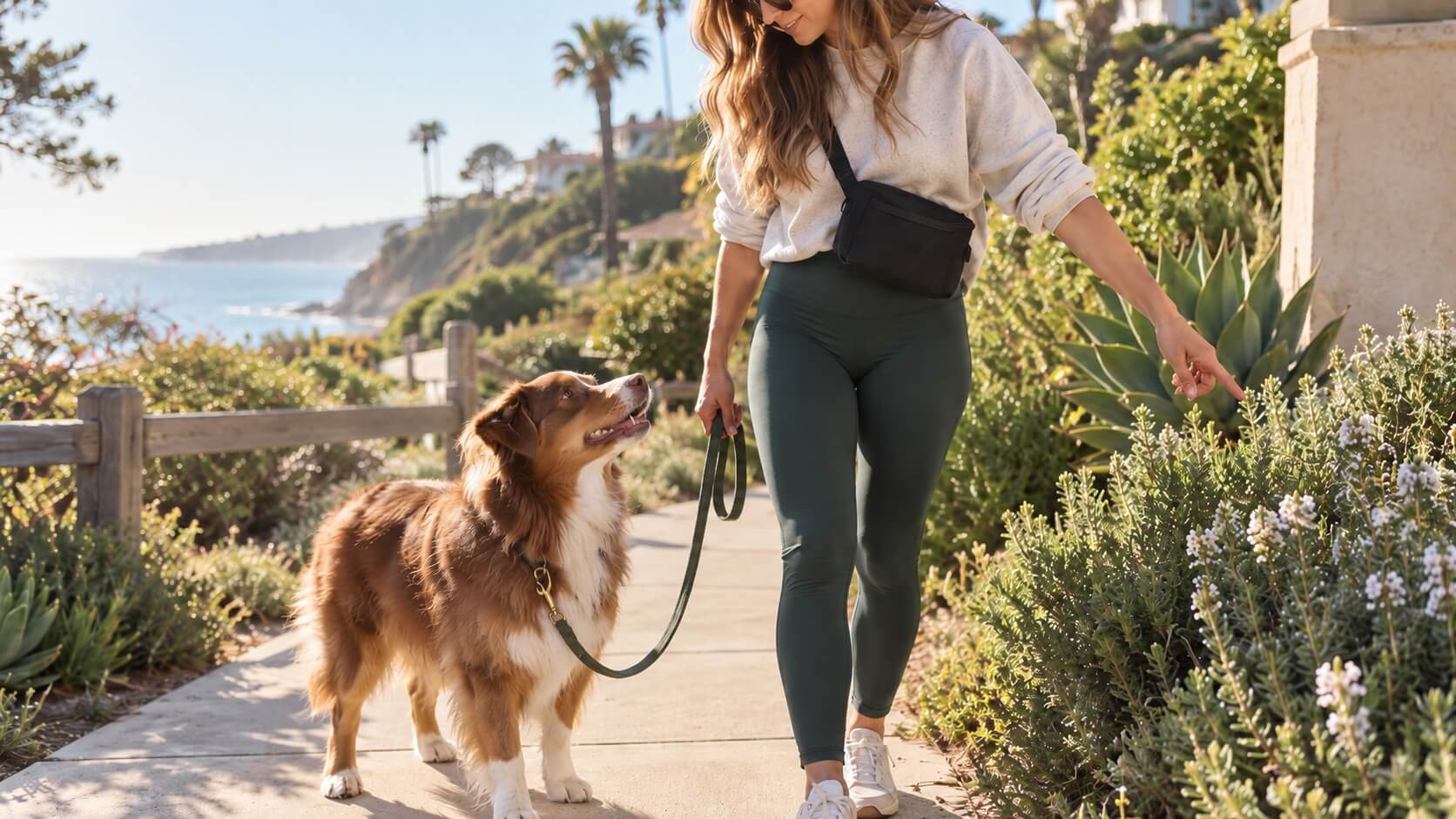
Rewards don’t always have to come from a treat bag. Sniffing, play and access to something your dog wants can reinforce behavior too.
Beyond the treat bag
Let everyday life help you reward good behavior
Once a cue is reliable, rewards do not always have to come from a treat pouch. Your dog wants things throughout the day: the door to open, the ball to be thrown, permission to sniff, a chance to go outside or the opportunity to return to whatever they were doing.
Those things can reinforce behavior too. If your dog wants to investigate an irresistible patch of grass, you might ask for an easy hand touch first. They touch your hand, you say “go sniff,” and access to the grass becomes the reward. At the back door, a sit might make the door open.
The difficulty of the behavior matters too. A sit in your kitchen and a recall away from a squirrel are not the same job, so they do not necessarily deserve the same paycheck. Easy behaviors may earn something ordinary. Difficult choices, especially safety-related ones, are worth reinforcing more generously.
Recall is a good example. If coming back to you always ends the fun, while ignoring you means another thirty seconds of glorious exploration, the environment is making a strong competing offer. Sometimes the best reward is food. Sometimes it is food and then permission to go explore again.
Try this today
The 2-minute “Where Are the Treats?” game
This is an easy exercise for dogs who have become experts at inspecting your hands before deciding whether you are worth listening to. Choose one familiar cue and keep the whole thing short.
| 01 | Put five treats in your pocket and keep your hands relaxed. |
| 02 | Ask for one easy behavior your dog already knows. |
| 03 | When your dog responds, mark the behavior and only then reach into your pocket. |
| 04 | When that feels easy, put the treats in a container on a nearby table and repeat. |
If your dog keeps glancing at your pocket, that is fine. They know where snacks live. What matters is whether they can respond before knowing exactly what the reward will be. Over time, you can mix in food, play, sniffing or access to something they want. The lesson becomes broader than “there is cheese in that pocket”: responding to you tends to lead somewhere good.
Make it practical
A simple progression you can actually use
You do not need a complicated training plan. Pick one behavior and move through these stages gradually. If your dog struggles when you move forward, go back one step and make it easy again.
The easy progression
✓ Stage 1: teach the new behavior generously with food.
✓ Stage 2: hide the food, but reward every correct response.
✓ Stage 3: move the rewards off your body — a nearby table or container works.
✓ Stage 4: once the cue is reliable, mix food with real-life rewards such as sniffing, play or access.
✓ Stage 5: keep difficult and important behaviors generously reinforced.
The goal isn’t a dog who works for nothing
There is no prize for using the fewest treats. Food is quick, convenient and highly motivating for many dogs, and continuing to use it does not mean you trained incorrectly. The more useful question is whether your dog can respond without needing to see the reward first.
Teach new skills generously. Move the lure out of sight as your dog begins to understand. Keep rewarding good choices while the behavior becomes reliable, and then let those rewards become more varied.
Sometimes the reward will be chicken. Sometimes it will be a tennis ball. Sometimes it will be permission to investigate the world’s most fascinating bush. The important lesson is the same: when I listen, good things tend to happen.
Sources & further reading
AVSAB: Humane Dog Training Position Statement
VCA Animal Hospitals: Puppy Behavior and Training — Training Basics
VCA Animal Hospitals: Using Predictable Rewards to Train Your Dog


