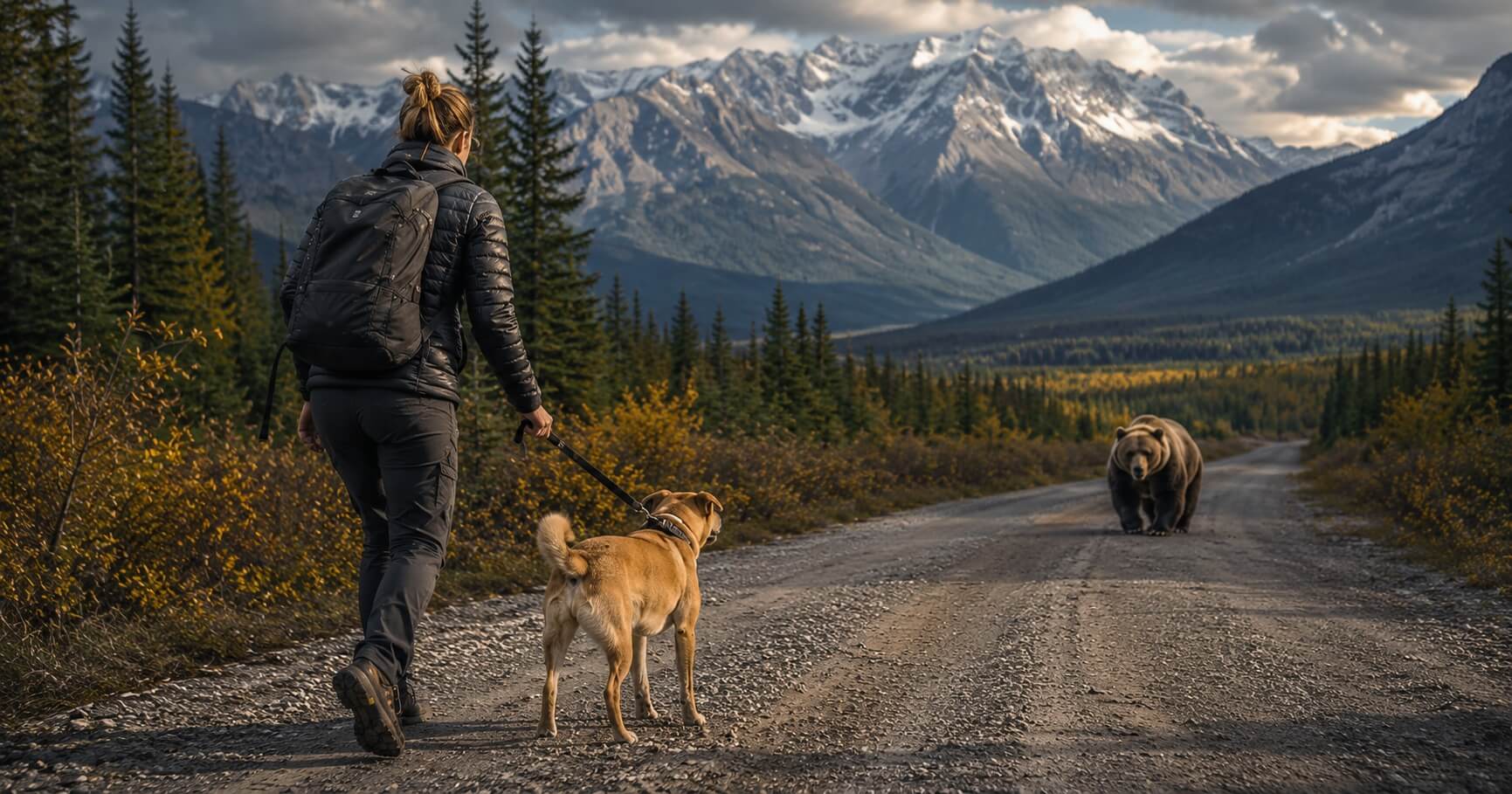
A morning dog walk in Alberta turned into the kind of close call nobody wants to imagine.
On June 24, a woman named Jessie was walking her dog, Skoki, near a wilderness camp in Alberta’s Kananaskis Country when a grizzly bear appeared on the gravel road ahead. According to Global News, the bear moved toward Jessie and Skoki, came within just a few feet, circled them several times, and at points reared up on its hind legs. Jessie backed away, yelled at the bear, and eventually escaped with her dog. Alberta Parks later issued a warning for the area around Mount Engadine Lodge, Mount Shark Road and Rummel Lake Trail after what officials described as persistent, dog-focused behaviour by a grizzly bear.
The video is scary because it looks so ordinary at first: a road, a dog, a morning walk. Then suddenly, it becomes a reminder that when dogs and wildlife share the same space, a normal outing can change fast.
Here’s what dog parents should know before walking in bear country.
First: your dog should be leashed
This is not just trail etiquette. It is safety.
Parks Canada says dogs can provoke defensive behaviour in bears and that pets should be kept under physical control in national parks and historic sites. In another wildlife safety guide, Parks Canada also says pets should be leashed and under control at all times when visiting areas with wildlife.
A dog off leash can run toward wildlife, bark, chase, or accidentally lead a bear back toward their human. Even a friendly, curious dog can change the mood of an encounter.
The takeaway: in bear country, the leash is not optional. It is part of the safety plan.
Check warnings before you go
Bear warnings and closures are not background noise. They are there because something has already happened or wildlife activity is high.
After the Alberta encounter, a bear warning was listed for the Mount Shark Road, Mount Engadine Lodge and Rummel Lake Trail area. Alberta Parks’ Kananaskis advisories page also showed multiple bear-related warnings and closures in the region around the same period.
Before a hike, trail walk or camping trip with your dog, check the park or local wildlife authority’s latest advisories. If an area has a bear warning, especially one involving dog-focused behaviour, choose another route.
Your dog does not need that trail. They need to get home safely.
Carry bear spray — and keep it reachable
Parks Canada recommends carrying bear spray in mountain parks and says it should be carried somewhere quickly accessible, like on your hip or chest. Their guidance also emphasizes knowing how to use it before you need it.
That part matters. Bear encounters can happen fast, and a dog leash already gives you one more thing to manage.
Worth knowing: bear spray is not bug spray. It is not sprayed on your dog, your clothes, your tent or the trail. It is an emergency deterrent, and local rules can vary depending on where you are.
Do not run
Parks Canada’s bear guidance says that if you see a bear, you should stop, stay calm, pull out your bear spray, assess the situation, and not run. Running may trigger pursuit. If the bear is aware of you, Parks Canada recommends speaking calmly and firmly, backing away slowly, and making yourself appear big.
With a dog, that means keeping the leash close, avoiding sudden movements, and creating distance without turning the moment into a chase.
No one is asking you to be fearless. The goal is to be boring, controlled, and not worth following.
Make noise before wildlife gets surprised
A lot of bear safety is not about what you do when the bear is already close. It is about lowering the chance of surprising one in the first place.
Parks Canada recommends making noise on the trail, especially near water, berry bushes, blind corners or thick forest where sound and visibility can be limited. It also recommends watching for bear signs like tracks, scat, diggings or carcasses, and leaving the area if signs are fresh.
For dog parents, this is especially important because your attention is often split: leash, trail, dog, other people, poop bags, phone, water, snacks.
The cute walk still needs situational awareness.
Secure the snacks, trash and pet food
Dogs are not the only attraction on a trail or campsite. Food smells matter too.
Parks Canada advises keeping campsites “bare” and packing away anything scented, including food, pet food, garbage, dishes and toiletries, inside a vehicle, hard-sided trailer or bear-proof storage container.
That includes your dog’s food bowl, treat pouch, chews, poop bags and anything else that smells interesting.
A dog-friendly camping setup is not just about bringing the collapsible bowl. It is also about not turning your site into a wildlife invitation.
The bottom line
The Alberta video is terrifying because it shows how quickly an everyday dog walk can become something much bigger.
Jessie and Skoki made it out safely. But the moment is a reminder for every dog parent who hikes, camps or walks in wild places: loving adventure means respecting where you are.
Keep your dog leashed. Check warnings. Carry bear spray where you can reach it. Make noise. Watch for signs. Do not run. And when the trail feels wrong, turn around.
Because the best outdoor day with your dog is not the one with the most dramatic story.
It is the one where you both come home.
Sources: The New York Times; video footage; Parks Canada; Alberta Parks.


