
Ancient Egypt is famous for its pyramids, pharaohs, and elaborate tombs. But beneath the sands of Saqqara, near Cairo, lies something you probably wouldn't expect: a vast underground burial site that once held an estimated eight million mummified animals, most of them dogs.
The catacombs had been known for more than a century, but when researchers from Cardiff University began investigating them in 2009, they discovered just how extensive the site really was. Their findings, published in 2015, revealed an extraordinary religious tradition that had left millions of animal remains beneath the desert.
These weren't simply pets buried by grieving owners. They were offerings to one of ancient Egypt's most recognizable gods, and understanding why so many ended up there takes us into a rather unusual corner of Egyptian history.
It All Began With a Jackal-Headed God
If you've ever seen an Egyptian figure with the head of a black canine, you've probably encountered Anubis. He was the god associated with mummification, burial rituals, and guiding the dead into the afterlife.
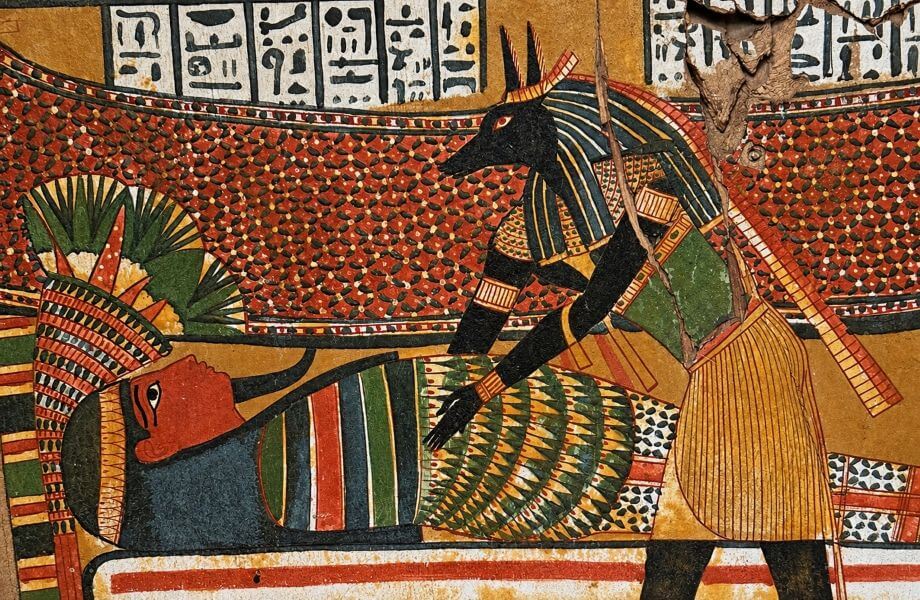
Ancient Egyptians believed animals could serve as connections to the gods. Because of their association with Anubis, dogs and other canines played an important role in religious offerings. Pilgrims visiting sacred sites could obtain a mummified animal to present as a prayer, a thank-you, or a request for divine protection.
Over generations, these offerings accumulated inside underground galleries. At Saqqara, the main passage alone stretched approximately 568 feet (173 meters), with smaller tunnels branching off into the limestone. Some galleries were once filled with layers of animal mummies around three feet deep.
And dogs weren't the only animals to receive this treatment. Across ancient Egypt, cats were mummified in honor of Bastet, ibises were associated with Thoth, and crocodiles with Sobek. Entire burial sites were dedicated to these animals, revealing just how deeply they were woven into Egyptian religious life.
An Ancient Industry Built Around Dogs
Producing millions of animal mummies wasn't a small operation. It required a steady supply of animals, people to prepare their bodies, and an entire network of priests, merchants, and workers serving pilgrims who visited the sacred sites.
Researchers believe breeding facilities probably operated around Saqqara to meet the demand. The number of animals was simply too large for them all to have been raised within the temple grounds.
One of the most surprising findings concerned the dogs' ages. Many were extremely young, including puppies that died within hours or days of birth. Researchers believe many were bred specifically for religious offerings, although the exact circumstances of their deaths remain unclear.
Not every dog received the same treatment, either. Researchers found a small number of older animals buried more carefully in individual niches. These may have been dogs kept within the temples, where they held a special status rather than being raised for ordinary offerings.
The catacombs also had an unexpected second life. Long after the religious tradition had ended, some of their contents were removed, apparently for use as fertilizer. Even centuries later, the enormous deposits of animal remains attracted attention for reasons their original creators could hardly have imagined.
A Different Kind of Egyptian Mystery
Ancient Egyptians didn't only associate dogs with the divine. They also kept them as hunting partners, guards, and household companions. Some were given names, appeared in tomb artwork, and were buried with care when they died.
One remarkable example is Abuwtiyuw, a dog described in an ancient inscription as a guard of the king who lived more than 4,000 years ago. An ancient inscription reveals that a pharaoh ordered a ceremonial burial for him, complete with a coffin from the royal treasury, fine linen, and incense. His name was preserved in stone, allowing us to know about him thousands of years later.
That makes the Catacombs of Anubis all the more fascinating. While individual dogs like Abuwtiyuw received extraordinary honors, millions of others were placed beneath the desert as religious offerings.
In ancient Egypt, being a sacred animal and being a beloved one weren't necessarily the same thing.
Sources: Antiquity (2015), Cardiff University, and Glencairn Museum. Image: AI-generated artistic interpretation inspired by ancient Egyptian animal mummification. Not an actual photograph of the Saqqara catacombs.


